William Colvill Camp 56Minneapolis / St. Paul |
|||||||||||||||||||||||||||||||
|
Camp Officers:
|
Col. William Colvill |
||||||||||||||||||||||||||||||
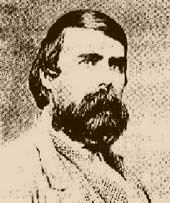
Camp Meetings
Camp 56 meets bi-monthly at the Scottish Rite Temple, 2011 Dupont Ave. S, Minneapolis, MN 55405, generally at 10 a.m. on the agreed upon Saturday by the membership. Contact Camp Secretary/Treasurer Mark Campbell, PCC for detail about upcoming meetings.
About Col. William Colvill
William Colvill was born at Forestville, Chautauqua County, New York, on April 5, 1830. He graduated from the Fredonia Academy, taught school for a year and then read Law in Millard Fillmore's office in Buffalo before being admitted to the New York Bar in 1851. He married Jane Elizabeth Morgan of Oneida County, who was a direct descendant of Elder Brewster, one of the Pilgrim Fathers. In 1854, they migrated to Minnesota, where he worked about a year in St. Paul as enrolling clerk and then secretary of the Territorial Council. The following year, Colvill went to Red Wing and established the Red Wing Sentinel, an independent Democratic paper, which he published until he enlisted in the Union Army.
When President Lincoln made his first call for volunteers, a war meeting was held at Red Wing. Colvill was the first to volunteer. He was elected Captain of Company F, 1st Minnesota Infantry. He was first wounded in the fighting on the Chichahominy; on the march to Gettysburg, he had a horse shot from under him and received some slight injuries; and in the charge at Gettysburg he was severely wounded twice in the hip and these crippled him for life.
Colvill participated in 28 battles, but is best known for leading the charge of the 1st Minnesota at Gettysburg, holding the Union line until reinforcements arrived and changing defeat to victory. He was mustered out on May 4, 1864, returned home, and improved from his wounds. That summer, he re-enlisted in the 1st Minnesota Heavy Artillery, was commissioned its Colonel, and served in and about Chattanooga until the close of the war. He was mustered out in July 1866.
After the war, Col. Colvill returned to Red Wing, where he practiced law, got involved in politics and continued to publish the Sentinel. He was elected a Representative to the State Legislature from Goodhue County in 1865 and 1878. He was State Attorney General from 1866 to 1868. In 1887, President Cleveland appointed him Register of the Duluth Land Office. He resigned that office in 1891and four years later, returned to his homestead, about seven miles northeast of Grand Marais. He spent the remaining years of his life living either on his homestead or on his farm near Red Wing.
Col. Colvill died in his sleep, June 14, 1905, at the Soldier's Home in Minneapolis, where he had come from Red Wing to attend a reunion of his old regiment. He is buried beside his wife in Cannon Falls. A bronze statue of Col. Colvill was placed in the rotunda of the Minnesota State Capitol in 1909. A replica of it at Cannon Falls was dedicated by President Coolidge in 1928.
Headstone Dedication Ceremony - 29 Sept 2024
The Sons of Union Veterans of the Civil War (SUVCW), Colonel Colvill Camp 56 is hosting a special ceremony at 2:00 pm on September 29, 2024 at the Lakewood Cemetery in Minneapolis, MN to dedicate over 50 new footstones for Civil War Soldiers who have been in unmarked graves for decades. All are welcome to join for this ceremony, which is followed by a tour of where the 1st and 2nd Minnesota soldiers are interred there.
- Dedication Ceremony (PDF)
- List of Union Soldiers being honored with a new footstone (PDF)
- Google map to Lakewood Cemetery
Camp Calendar Days the flag should be flown
| 26 May: |  Memorial Day Memorial Day |
| 31 May: | Last Union Veteran Ceremony in Aitkin County, 1 p.m., Greenwood Cemetery, Glenville Last Union Veterans Ceremony in Waseca County, 3 p.m., Woodville Cemetery, Waseca |
| 7 June: | Dept. of Wisconsin Encampment, Town of Norway Town Hall (right-click on this link and choose "save link as" to download encampment registration form file) |
| 7 June: | Last Union Veteran Ceremony in Freeborn County, 1 p.m., Hill Lake Cemetery, Hill City |
| 14 June: | Flag Day |
| 14 June: | Camp 56 meeting, 10 a.m., Minneapolis Scottish Rite Temple |
| 21 June: | Last Union Veteran Ceremony in Yellow Medicine County, 1 p.m., East Yellow Medicine Lutheran Cem., Hanley Falls Last Union Veteran Ceremony in Chippewa County, 3 p.m., Sunset Memorial Cemetery, Montevideo |
| 22 June: | Last Union Veteran Ceremony in Big Stone County, 10 a.m., Mound Cemetery, Ortonville Last Union Veteran Ceremony in Lincoln County, 1 p.m., Hope Cemetery, Tyler Last Union Veteran Ceremony in Lyon County, 3 p.m., Marshall Cemetery, Marshall |
| 4 July: | Independence Day |
| 2 Aug: | Camp 56 meeting, 10 a.m., Minneapolis Scottish Rite Temple |
| 7-10 Aug: | 144th National Encampment, Houston, Texas (hosted by the Dept. of Texas) |
Recent Activities
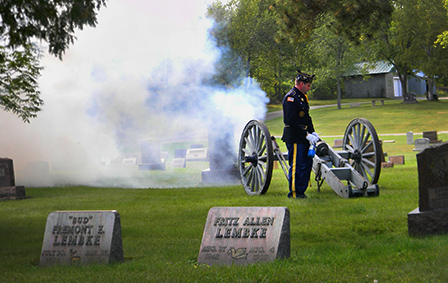 |
Last Soldier Ceremony. William Colvill Camp 56 played Taps one final time Louis Edward Quint, the Last Union Veteran from Cass County, Minnesota. The Walker American Legion Post #134 Honor Guard assisted during the ceremony. A rifle team, bugler, flag bearers, and chaplain provided additional assistance, along with an artillery team that arranged a cannon salute to Quint. Camp 56 Brother James Johnson delivered remarks about Quint's life and military service. As a member of the GAR, Quint served as National Patriotic Instructor in 1944. Photo credit: Donna Johnson. |
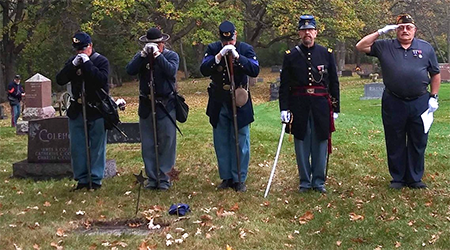 |
Last Soldier Ceremony. Camp 56 conducted a Last Soldier dedication ceremony for James A. "Cap" Colehour, who served in Company I of the 92nd Regiment of Illinois Volunteer Infantry. Private Colehour died in 1938 and was the last Union soldier to be buried in Otter Tail County, Minnesota, in Lakewood Cemetery, Battle Lake, Minnesota. Pictured at left: Members of the First Minnesota Volunteer Infantry perform Rest on Arms during the playing of Taps at the Last Soldier dedication ceremony for Private James A. "Cap" Colehour. Participating are Pat Chase and John Taylor of the First Minnesota, Camp 56 members Gary Carlberg and Doug Urbanski. At attention is Brother Jimmy Johnson. Photo credit: Donna Johnson. |
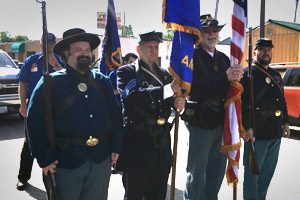 |
Litchfield Memorial Day Parade. Members of Camp 56 prepare to March in the Litchfield, MN Memorial Day Parade. Left to right: Andrew Willenbring, PCC, Bruce Nelson, Mark Campbell, PCC, Doug Urbanski, PCC. |

Sons of Union Veterans of the Civil War
Department of Wisconsin
Comments to Dept. Signals Officer
Last Updated: 20 May 2025